
How AI is Revolutionizing ENT Care in 2026 — What Every Patient Must Know

By Dr. Sanjeev Mohanty | ENT, Head & Neck Surgeon | Dr. Mohanty's Speciality ENT Clinics, Chennai
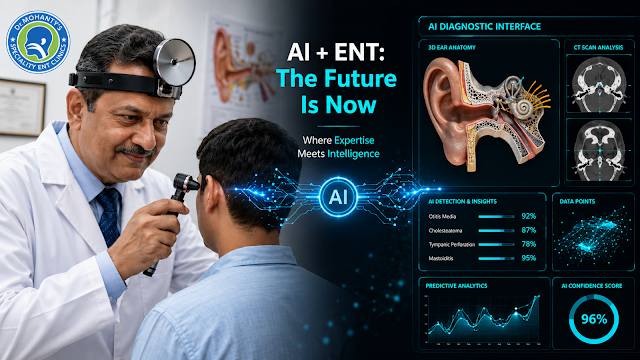
Let me be honest with you. When I first started practicing ENT medicine over 25 years ago, diagnosing a patient with a middle ear infection meant looking through a handheld otoscope, relying on experience, and a lot of clinical intuition. Today, Artificial Intelligence is sitting right next to us in the consultation room — and it is changing everything.
This isn't science fiction. It isn't a futuristic concept. It's happening right now, in 2026, in hospitals and clinics around the world — including right here in Chennai. And as someone who has spent decades treating patients with ear, nose, and throat conditions, I want to break this down in plain language for you.
First — What Exactly is AI Doing in ENT Medicine?
Artificial Intelligence, in the context of healthcare, is essentially a computer program that has been trained on millions of medical cases, images, test results, and patient records. It learns patterns the way a doctor learns from years of seeing patients — only it processes information at a speed and scale no human brain can match.
In ENT specifically, AI is being applied in several powerful ways:
• Diagnosing ear infections from otoscope images with near-doctor accuracy
• Detecting early signs of head and neck cancers from CT and MRI scans
• Predicting outcomes after sinus surgeries by analysing patient data
• Helping patients understand their symptoms before they even walk into a clinic
• Assisting cochlear implant programming for hearing-impaired patients
According to a 2024 study published in PubMed, the most heavily researched AI topics in ENT include cochlear implants, head and neck cancer detection, hearing loss diagnosis, and chronic rhinosinusitis — all conditions that I see regularly in my practice.
AI in Ear Diagnosis — Can a Computer Spot What a Doctor Might Miss?
One of the most exciting developments is AI-powered otoscopy. Traditional ear examination requires a trained eye. Conditions like otitis media (middle ear infection), cholesteatoma, and tympanic membrane perforations can sometimes present subtly, especially in children who can't always describe their symptoms clearly.
AI systems are now being trained on thousands of otoscope images. These systems can identify abnormalities with an accuracy that rivals — and in some studies exceeds — general practitioners. For patients in remote areas without easy access to an ENT specialist, this is genuinely life-changing.
"In my clinic, I use technology not to replace my clinical judgement, but to extend it. A second set of 'eyes' — even if digital — can only benefit my patients." — Dr. Sanjeev Mohanty, ENT Surgeon, Chennai |
AI and Head & Neck Cancer — Earlier Detection Saves Lives
Head and neck cancers are among the most treatable when caught early — but tragically, many cases are diagnosed too late. AI is now being deployed to analyse radiology images (CT, MRI, PET scans) and flag suspicious lesions that a tired radiologist might overlook.
At major cancer centres globally, AI-assisted radiomics is helping oncologists identify tumour boundaries, predict lymph node involvement, and assess treatment response — all with greater consistency than was previously possible.
For patients, this translates into one simple thing: a better chance of catching cancer at Stage I or II, when the 5-year survival rates are dramatically higher.
AI in Sinus Disease and Rhinology
Chronic sinusitis is one of the most common ENT conditions I encounter. Millions of people worldwide suffer from blocked sinuses, facial pressure, and recurring infections. Endoscopic sinus surgery, when needed, requires careful planning.
AI tools are now being used to predict post-operative outcomes in sinus surgery — helping surgeons like me decide when surgery is truly necessary and what results a patient can realistically expect. This means fewer unnecessary procedures and better patient counselling.
AI is also assisting in CT scan analysis for chronic rhinosinusitis, automatically scoring the extent of disease (what we call the Lund-Mackay score) in seconds — a task that previously required manual review.
The ChatGPT Revolution in Patient Education
A research paper in the NIH's PubMed database noted that tools like ChatGPT are beginning to play a role in helping patients triage ENT symptoms — from nasal congestion to snoring — reducing unnecessary emergency visits and helping people make more informed decisions about when to see a specialist.
This matters enormously in a country like India, where access to specialist care is not equal across all populations. A patient in a smaller town who is unsure whether their child's ear pain needs urgent attention can now use AI to get preliminary guidance.
That said — and I want to be very clear about this — AI is a support tool. It is not a doctor. It cannot examine you, cannot touch you, cannot pick up the nuance of your voice, your face, your anxiety. The art of medicine remains irreducibly human.
What This Means for You as a Patient in Chennai
If you visit Dr. Mohanty's Speciality ENT Clinics, you will notice that while we embrace technology, the consultation remains deeply personal. Over 25 years of practice, I have learned that patients don't just want a diagnosis — they want to be heard, to understand their condition, and to trust their doctor.
What AI does is give us better tools to serve you. Faster diagnosis. More accurate imaging review. Better pre-surgical planning. But the decision, the explanation, the reassurance — that will always come from a human being sitting across the table from you.
Looking Ahead — What's Coming in 2026 and Beyond?
• Wearable ENT sensors that monitor ear canal health in real time
• AI-powered tinnitus management apps personalised to your hearing profile
• Robot-assisted cochlear implant surgeries with AI guidance
• Voice analysis tools that detect laryngeal cancer risk from how you speak
• AI chatbots in multiple regional languages, including Tamil
The field is evolving rapidly. As an ENT surgeon, I find it both exciting and humbling. Exciting because better tools mean better outcomes for my patients. Humbling because it reminds us that medicine, at its core, is about human beings taking care of other human beings.
Conclusion — Embrace the Technology, but Trust Your Doctor
AI in ENT is not a threat — it is an opportunity. An opportunity to catch diseases earlier, to treat more accurately, and to educate patients more effectively. Whether you're dealing with a stubborn sinus infection, concerned about hearing loss, or have been noticing a lump in your neck, the message is simple: don't wait, don't self-diagnose via Google, and come see a specialist.
At Dr. Mohanty's Speciality ENT Clinics in Chennai, we combine over 25 years of surgical expertise with the latest diagnostic technology — including AI-assisted tools — to give you the most accurate, compassionate care possible.
Because at the end of the day, the best technology in the world is only as good as the hands and the heart behind it.
📞 Book an Appointment: +91 97910 74677
📍 Location: 3, 234 Manapakkam Main Road, opposite Jains Avantika, Manapakkam, Chennai – 600125
🌐 Website: www.drsanjeevmohanty.com
#ENTChennai #AIinHealthcare #DrSanjeevMohanty #ENTDoctor #HeadAndNeckSurgery #SinusTreatment #HearingLoss #TechInMedicine
Let me be honest with you. When I first started practicing ENT medicine over 25 years ago, diagnosing a patient with a middle ear infection meant looking through a handheld otoscope, relying on experience, and a lot of clinical intuition. Today, Artificial Intelligence is sitting right next to us in the consultation room — and it is changing everything.
This isn't science fiction. It isn't a futuristic concept. It's happening right now, in 2026, in hospitals and clinics around the world — including right here in Chennai. And as someone who has spent decades treating patients with ear, nose, and throat conditions, I want to break this down in plain language for you.
First — What Exactly is AI Doing in ENT Medicine?
Artificial Intelligence, in the context of healthcare, is essentially a computer program that has been trained on millions of medical cases, images, test results, and patient records. It learns patterns the way a doctor learns from years of seeing patients — only it processes information at a speed and scale no human brain can match.
In ENT specifically, AI is being applied in several powerful ways:
• Diagnosing ear infections from otoscope images with near-doctor accuracy
• Detecting early signs of head and neck cancers from CT and MRI scans
• Predicting outcomes after sinus surgeries by analysing patient data
• Helping patients understand their symptoms before they even walk into a clinic
• Assisting cochlear implant programming for hearing-impaired patients
According to a 2024 study published in PubMed, the most heavily researched AI topics in ENT include cochlear implants, head and neck cancer detection, hearing loss diagnosis, and chronic rhinosinusitis — all conditions that I see regularly in my practice.
AI in Ear Diagnosis — Can a Computer Spot What a Doctor Might Miss?
One of the most exciting developments is AI-powered otoscopy. Traditional ear examination requires a trained eye. Conditions like otitis media (middle ear infection), cholesteatoma, and tympanic membrane perforations can sometimes present subtly, especially in children who can't always describe their symptoms clearly.
AI systems are now being trained on thousands of otoscope images. These systems can identify abnormalities with an accuracy that rivals — and in some studies exceeds — general practitioners. For patients in remote areas without easy access to an ENT specialist, this is genuinely life-changing.
"In my clinic, I use technology not to replace my clinical judgement, but to extend it. A second set of 'eyes' — even if digital — can only benefit my patients." — Dr. Sanjeev Mohanty, ENT Surgeon, Chennai |
AI and Head & Neck Cancer — Earlier Detection Saves Lives
Head and neck cancers are among the most treatable when caught early — but tragically, many cases are diagnosed too late. AI is now being deployed to analyse radiology images (CT, MRI, PET scans) and flag suspicious lesions that a tired radiologist might overlook.
At major cancer centres globally, AI-assisted radiomics is helping oncologists identify tumour boundaries, predict lymph node involvement, and assess treatment response — all with greater consistency than was previously possible.
For patients, this translates into one simple thing: a better chance of catching cancer at Stage I or II, when the 5-year survival rates are dramatically higher.
AI in Sinus Disease and Rhinology
Chronic sinusitis is one of the most common ENT conditions I encounter. Millions of people worldwide suffer from blocked sinuses, facial pressure, and recurring infections. Endoscopic sinus surgery, when needed, requires careful planning.
AI tools are now being used to predict post-operative outcomes in sinus surgery — helping surgeons like me decide when surgery is truly necessary and what results a patient can realistically expect. This means fewer unnecessary procedures and better patient counselling.
AI is also assisting in CT scan analysis for chronic rhinosinusitis, automatically scoring the extent of disease (what we call the Lund-Mackay score) in seconds — a task that previously required manual review.
The ChatGPT Revolution in Patient Education
A research paper in the NIH's PubMed database noted that tools like ChatGPT are beginning to play a role in helping patients triage ENT symptoms — from nasal congestion to snoring — reducing unnecessary emergency visits and helping people make more informed decisions about when to see a specialist.
This matters enormously in a country like India, where access to specialist care is not equal across all populations. A patient in a smaller town who is unsure whether their child's ear pain needs urgent attention can now use AI to get preliminary guidance.
That said — and I want to be very clear about this — AI is a support tool. It is not a doctor. It cannot examine you, cannot touch you, cannot pick up the nuance of your voice, your face, your anxiety. The art of medicine remains irreducibly human.
What This Means for You as a Patient in Chennai
If you visit Dr. Mohanty's Speciality ENT Clinics, you will notice that while we embrace technology, the consultation remains deeply personal. Over 25 years of practice, I have learned that patients don't just want a diagnosis — they want to be heard, to understand their condition, and to trust their doctor.
What AI does is give us better tools to serve you. Faster diagnosis. More accurate imaging review. Better pre-surgical planning. But the decision, the explanation, the reassurance — that will always come from a human being sitting across the table from you.
Looking Ahead — What's Coming in 2026 and Beyond?
• Wearable ENT sensors that monitor ear canal health in real time
• AI-powered tinnitus management apps personalised to your hearing profile
• Robot-assisted cochlear implant surgeries with AI guidance
• Voice analysis tools that detect laryngeal cancer risk from how you speak
• AI chatbots in multiple regional languages, including Tamil
The field is evolving rapidly. As an ENT surgeon, I find it both exciting and humbling. Exciting because better tools mean better outcomes for my patients. Humbling because it reminds us that medicine, at its core, is about human beings taking care of other human beings.
Conclusion — Embrace the Technology, but Trust Your Doctor
AI in ENT is not a threat — it is an opportunity. An opportunity to catch diseases earlier, to treat more accurately, and to educate patients more effectively. Whether you're dealing with a stubborn sinus infection, concerned about hearing loss, or have been noticing a lump in your neck, the message is simple: don't wait, don't self-diagnose via Google, and come see a specialist.
At Dr. Mohanty's Speciality ENT Clinics in Chennai, we combine over 25 years of surgical expertise with the latest diagnostic technology — including AI-assisted tools — to give you the most accurate, compassionate care possible.
Because at the end of the day, the best technology in the world is only as good as the hands and the heart behind it.
📞 Book an Appointment: +91 97910 74677
📍 Location: 3, 234 Manapakkam Main Road, opposite Jains Avantika, Manapakkam, Chennai – 600125
🌐 Website: www.drsanjeevmohanty.com
#ENTChennai #AIinHealthcare #DrSanjeevMohanty #ENTDoctor #HeadAndNeckSurgery #SinusTreatment #HearingLoss #TechInMedicine

Follow Us:
1. Facebook: www.facebook.com/entdrmohanty
2. Instagram: www.instagram.com/entdrmohanty
3. Blog: www.drmohantyss.blogspot.com
4. X: www.x.com/entdrmohanty
5. LinkedIn: www.linkedin.com/company/entdrmohanty
6. Website: www.drsanjeevmohanty.com


Comments